Five free Astro documentation themes have a live preview you can open today, checked on November 15, 2026. Stratus suits a docs site that non-developers edit in CloudCannon, Knowledge Core suits technical docs with a course app and an AI chat, Astro AI Docs adds an Ask AI dialog to Starlight, SupportGenix Docs suits a help center, and Flect is a small docs site with nothing to remove. If you would rather install a theme package than clone a site, Starlight is the default. Jump to the quick picks.
Quick picks
Quick picks
- Docs that non-developers edit in a browserStratusCloudCannon visual editing, Pagefind search, MIT
- Technical docs with a course and an AI chatKnowledge Corea docs app, a course app and a chat on Cloudflare, MIT
- Starlight with answers from your own pagesAstro AI Docsan Ask AI dialog and llms.txt, MIT
- A help center or knowledge baseSupportGenix Docscategories, related articles and feedback, ISC
- A small docs site with nothing to removeFlectno plugin system, analytics off by default, MIT
How we checked
We started from the top five Google results for “astro documentation template”, which include the Astro theme catalog, a Starlight tutorial and a Reddit thread. Then we searched GitHub for Astro docs themes pushed in the last year. For each candidate we read the LICENSE, the astro version in package.json, the last commit and the README on November 15, 2026, and opened its live preview.
A theme made the list only with all three: a live preview that returned a page, a GitHub source, and a license that lets you change the code. It also needed an Astro version no more than one major behind Astro 7 and a commit in the last 12 months. Every preview image below is a screenshot we took of that live preview. We did not install or build any of the five, so the notes report what each README, package.json and preview shows.
Stars are shown for context only. All five have fewer than ten, so a star count does not separate them. None of the picks is a Getastrothemes product, and we have no commercial relationship with their authors. We do not sell a documentation theme, so this list is free picks only.
1. Stratus
Free and open source, MIT. A documentation starter from CloudCannon, built for visual editing in the browser.
Best for
A product team whose docs website is written by people who do not use Git, and who will host the editing in CloudCannon.
- License
- MIT
- Astro version
- ^7.2.0 in package.json
- Node version
- 22.12.0 or newer
- Last commit
- October 23, 2026
- GitHub stars
- 1
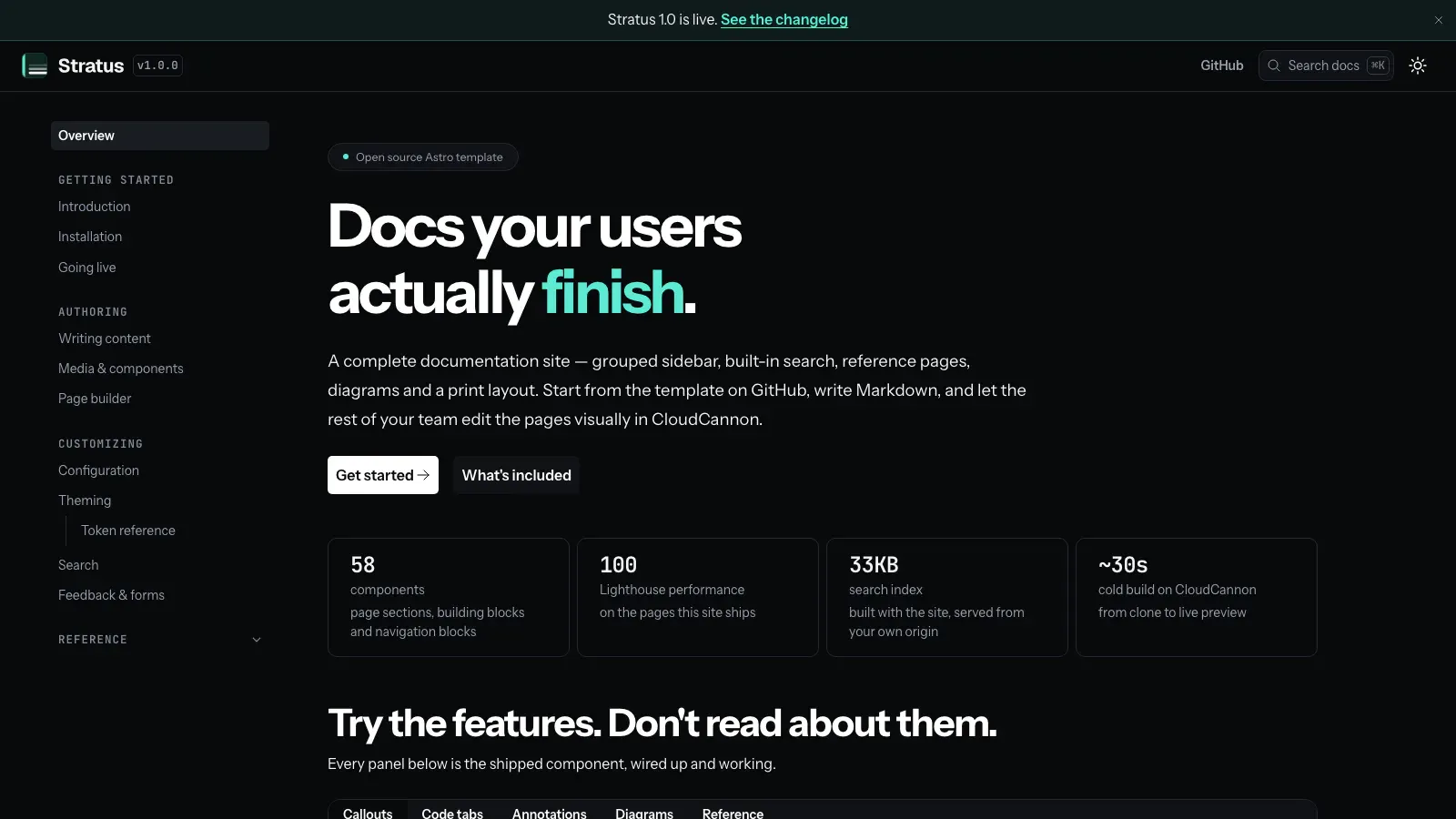
Stratus ships search, dark mode, a sitemap, a print layout and MDX pages, and its package.json includes Pagefind for search. The README says you clone it and own it, and it links a CloudCannon deploy button. The preview opens on a page titled “Overview | Stratus”, with a sidebar grouped into Getting started, Authoring, Customizing and Reference.
Before you publish, run npm run reset:starter. It asks for a site name and production URL, then writes the URL to site in astro.config.mjs. The README says every canonical URL, sitemap entry and JSON-LD record is built from that value. Left at its placeholder, they point at a domain you do not own, and nothing errors. npm run check warns until it is set.
Pros
- Pagefind search and a sitemap are in the theme, not added later
- A CloudCannon deploy button in the README for browser-based editing
- One setup command sets the production URL everywhere it is used
Cons
- The visual editing path is built around CloudCannon; on another host, you edit the content files directly
- One star, so little outside use to judge it by; read the commit history before you rely on it
2. Knowledge Core
Free and open source, MIT. A pnpm monorepo with a docs app, a course app and an AI chat assistant.
Best for
Technical documentation that sits next to a course or tutorial track, for a team that already runs on Cloudflare.
- License
- MIT
- Astro version
- Astro v7 per the README
- Node version
- 22.12.0 or newer, pnpm 9 or newer
- Last commit
- November 14, 2026
- GitHub stars
- 4
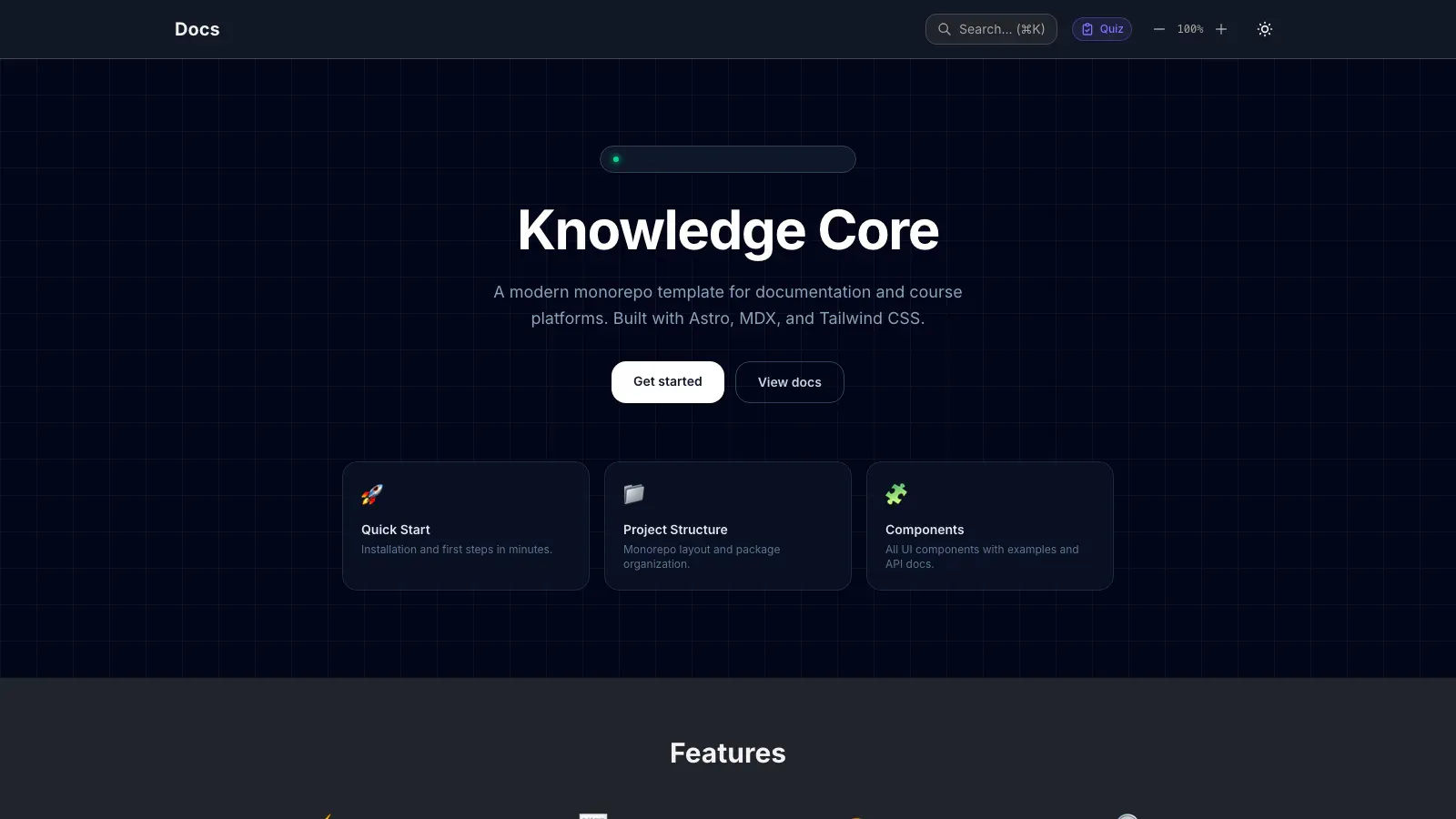
The README describes Astro v7, MDX, Tailwind CSS v4 and a second app for courses, and it names a retrieval chat assistant built on Cloudflare Vectorize and Workers AI. It also lists a post-build audit for SEO and accessibility, and a sidebar you configure with defineSidebar(). The preview opens on a page titled “Knowledge Core - Documentation”, and its HTML includes an Open Graph image tag.
Pros
- The widest scope of the five: docs, a course app and search in one repository
- Committed to on November 14, 2026, the day before this check
- A post-build SEO and accessibility audit is part of the setup
Cons
- More moving parts than a docs starter: a monorepo, two apps and an AI chat that depends on Cloudflare
- The root package.json has no astro dependency; the Astro version comes from the workspace apps, so check those first
3. Astro AI Docs
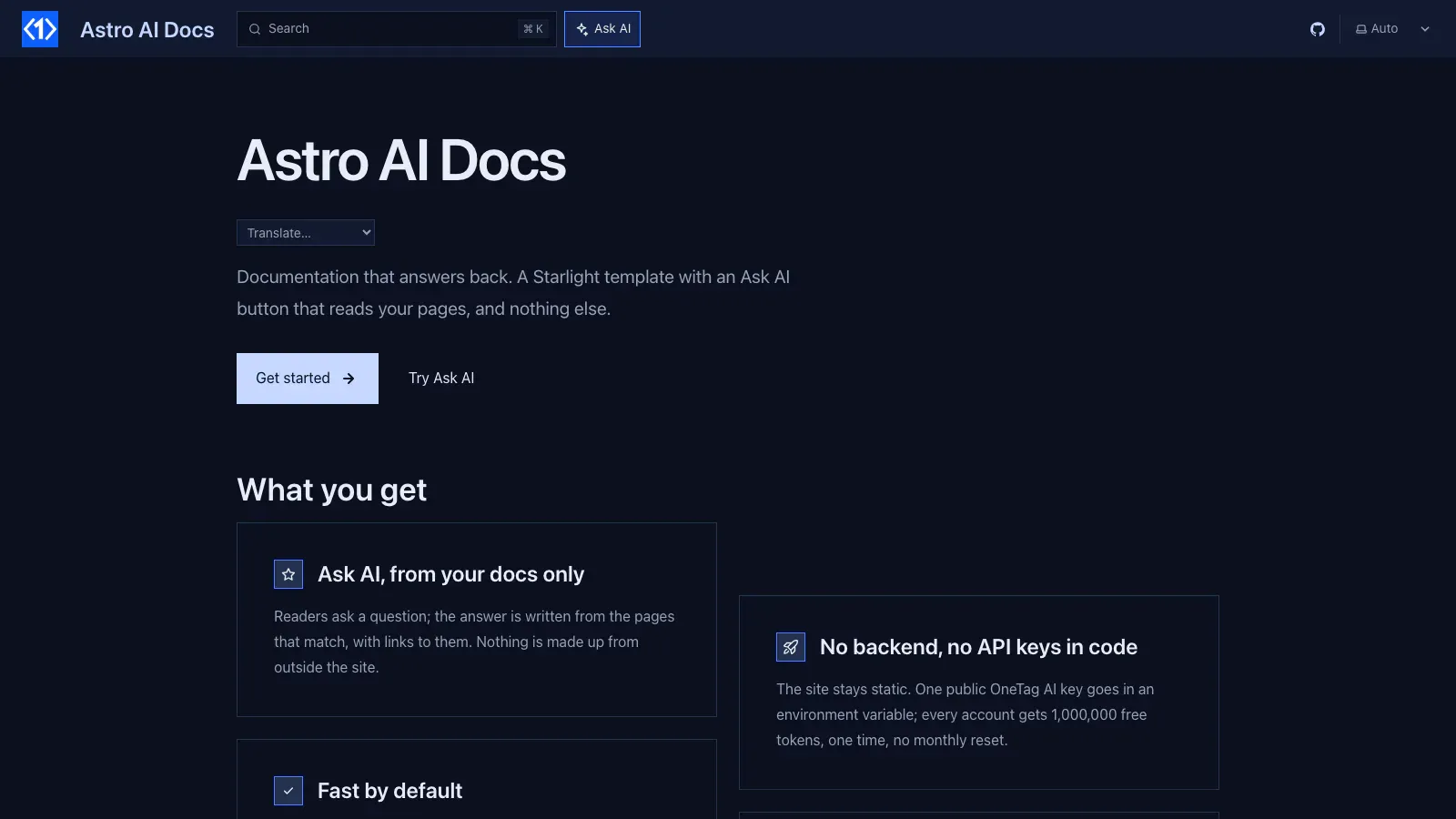
Free and open source, MIT. A Starlight docs theme with an Ask AI dialog that answers from your own pages.
Best for
A team that wants Starlight’s structure as a ready site, with readers able to ask questions of the docs.
- License
- MIT
- Astro version
- ^7.3.6 in package.json, Starlight ^0.42.10
- Last commit
- November 11, 2026
- GitHub stars
- 1
- AI service
- OneTag AI, which needs its own key before you deploy
Everything apart from the AI features is standard Starlight: sidebar, search, dark mode and i18n. The README says the Ask AI dialog searches the site’s own Pagefind index, sends the best five pages and the question to OneTag AI, and answers only from your pages. Each build also writes an llms.txt file. The preview has the Ask AI button in its header, next to search, and the README says it also opens with Ctrl + /.
On localhost the dialog runs on a shared demo key. Before you deploy, the README asks you to get your own OneTag key and set PUBLIC_ONETAG_KEY. Without a key, a deployed site works as a normal Starlight site.
Pros
- Starlight underneath, so its upstream updates and docs still apply
- The AI script loads only when the dialog opens, per the README
- Deploy buttons for Vercel and Netlify, and a GitHub Pages workflow
Cons
- The Ask AI feature depends on a third-party service and its key
- One star and one maintainer, so read the commit log before you rely on it
4. SupportGenix Docs
Free and open source, ISC. A documentation and knowledge base theme shaped like a help center.
Best for
A product’s help center or knowledge base, where readers browse by category rather than read pages in order.
- License
- ISC, which allows modified copies with the notice kept
- Astro version
- ^6.1.3 in package.json, one major behind Astro 7
- Node version
- 22.12.0 or newer, per the README
- Last commit
- May 29, 2026
- GitHub stars
- 9
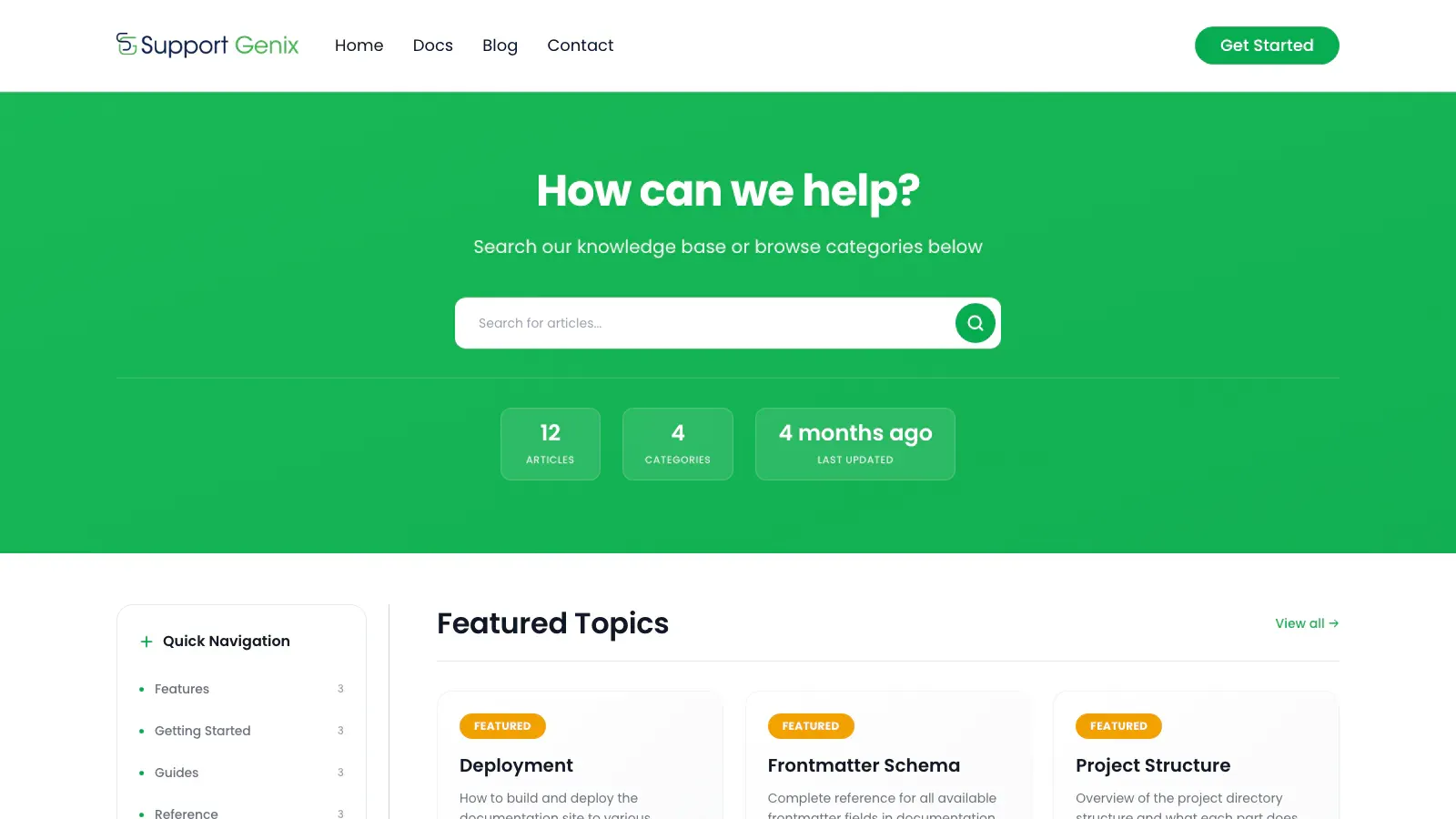
The README lists MDX content collections, Pagefind search with a JSON fallback, Tailwind CSS 4, Alpine.js, category pages, related articles and a “Was this helpful?” widget that stores answers in localStorage. It also ships a CLI, npm create supportgenix-docs@latest, that adds the docs to existing Astro 6 or newer projects. Brand, links and social accounts live in one config file. The preview opens on a “How can we help?” search box, with counts of 12 articles and 4 categories below it.
Pros
- The only pick laid out as a help center, with categories and related articles
- Can be added to an existing Astro site with one command, or cloned whole
- The most GitHub stars of the five, though still few
Cons
- On Astro 6, so plan a future upgrade to Astro 7 and check the astro line in package.json first
- The feedback widget stores answers in each reader’s browser only, so you do not see them
5. Flect
Free and open source, MIT. A lightweight docs theme with no plugin system and nothing to remove.
Best for
A small project or library that needs a fast docs site and few decisions to undo.
- License
- MIT
- Astro version
- ^7.1.3 in package.json
- Node version
- 22.12.0 or newer
- Last commit
- July 23, 2026
- GitHub stars
- 1
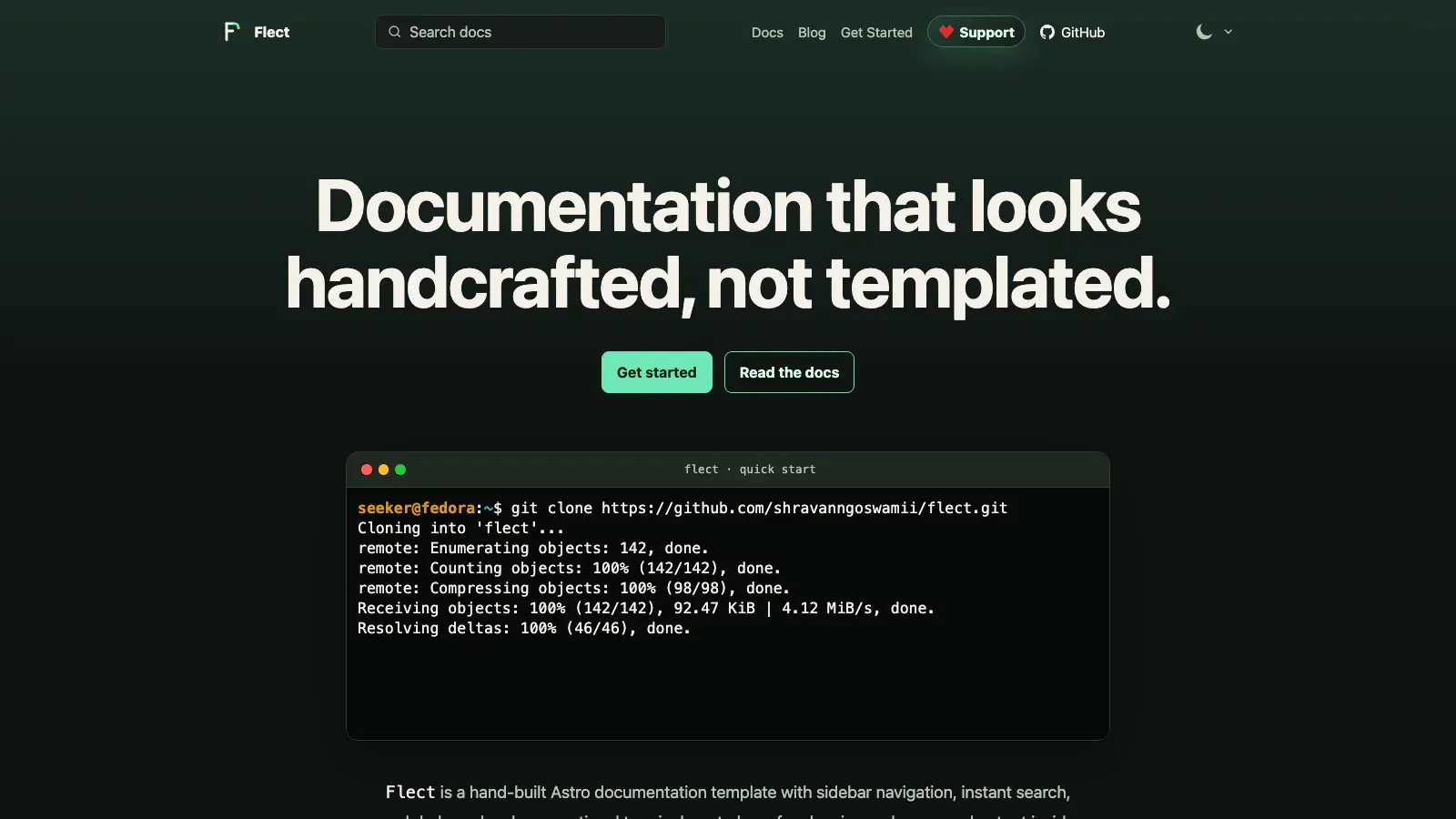
Flect’s package.json includes Pagefind and the sitemap integration. The README says Umami analytics is wired in and silent until you add an ID, so nothing is tracked by default. The sidebar structure is in src/data/navigation.ts, and the README lists 40+ color themes, each in light and dark. The preview opens on a hero above a terminal block showing the git clone command.
Pros
- Small and easy to read, with few decisions to undo
- Analytics is off until you configure it
- Pagefind search is built by
npm run build
Cons
- The last commit is from July 2026, the oldest of the MIT picks
- One maintainer, and the preview sits on that maintainer’s own domain
Starlight, if you would rather install a theme
Starlight is the docs theme the Astro team maintains. It is MIT licensed, and on November 15, 2026 its package declared a peer dependency of astro ^7.2.10, with 9,586 GitHub stars. It covers what most documentation sites need: a sidebar, search, internationalization, and pages in Markdown or MDX.
Pick Starlight when you want updates from its maintainers and can accept its layout. Pick one of the five themes when you want the whole site copied into your repository and do not plan to upgrade a theme package. Astro AI Docs sits between the two: it is a theme you clone, with Starlight inside it.
What to change first after cloning
Whichever pick you start from, customize the same four areas before the site goes live:
- Site URL and metadata. Stratus builds its canonical URLs, sitemap and JSON-LD from one value, and SupportGenix Docs keeps brand and links in one config file. Set the production URL before you check search results.
- Navigation. Stratus keeps each page as an MDX file in
src/content/docs. Flect keeps its sidebar insrc/data/navigation.ts, Knowledge Core usesdefineSidebar(), and Astro AI Docs sets it inastro.config.mjs. - Components. Stratus documents its MDX components and diagrams on a page of its own. Knowledge Core has shared components across its two apps. In every pick, the layouts and
src/componentsdecide the look of the site, so change those before anything deeper. - Languages. Astro AI Docs inherits Starlight’s i18n. We did not verify multi-language support in the other four, so do not assume one until you have tested it.
Tip
Replace the sample content first, then the colors. Changing the content keeps the theme’s navigation and search working. If a theme fails to build, open an issue on its repository before you fork it, so you can find out whether the problem is yours.
Watch out
Two picks lean on an outside service for AI: Knowledge Core’s chat needs a Cloudflare account, and Astro AI Docs needs a OneTag key. Skip those features if you do not want to run them.
Which one to start from
| If you need | Start from | License | Astro | AI chat |
|---|---|---|---|---|
| Editors who work in a browser | Stratus | MIT | 7 | No |
| Technical docs with a course | Knowledge Core | MIT | 7 | Yes, Cloudflare |
| Starlight with answers from your pages | Astro AI Docs | MIT | 7 | Yes, OneTag |
| A help center by category | SupportGenix Docs | ISC | 6 | No |
| A small site with nothing extra | Flect | MIT | 7 | No |
To set up whichever you choose, installing an Astro theme covers cloning, npm install and the dev server with a sample project. For what MIT and ISC allow in client work, see Astro theme licenses explained.
We read these and left them out
- advanced-astro/astro-docs-template: 92 stars and a top-five result, but GitHub detects no license, so the terms are not stated. Its package.json declares astro ^3.5.5, more than two majors behind.
- theotterlord/manual: MIT, but declares astro ^2.0.10 and its last push was October 2, 2023.
- jazzypants1989/astro-docs-template: no LICENSE file on the default branch.
- RookDuel/Setu: MIT with a working preview, but declares astro ^5.6.1, two majors behind.
- deltaqdev/mines: MIT, but it is a theme package you install, like Starlight, not a site you clone.
- qwexvf/astro-docs-template: MIT on Astro 6 with a preview, but a minimal docs site is what Flect already covers, on Astro 7.
What this list does not cover
We did not install or build any of the five, so this list does not report build times or Lighthouse scores. It does not cover API reference generators, blogs, portfolios or landing pages. For a blog, see our free Astro blog themes. For a site that is mostly marketing pages, see our Astro starter themes.